Kuro Africa · Market entry strategySample report · Abridged
KUROAFRICASample report
Market entry strategy · Cold storage

Cold storage in the Tema corridor: does real demand exist?

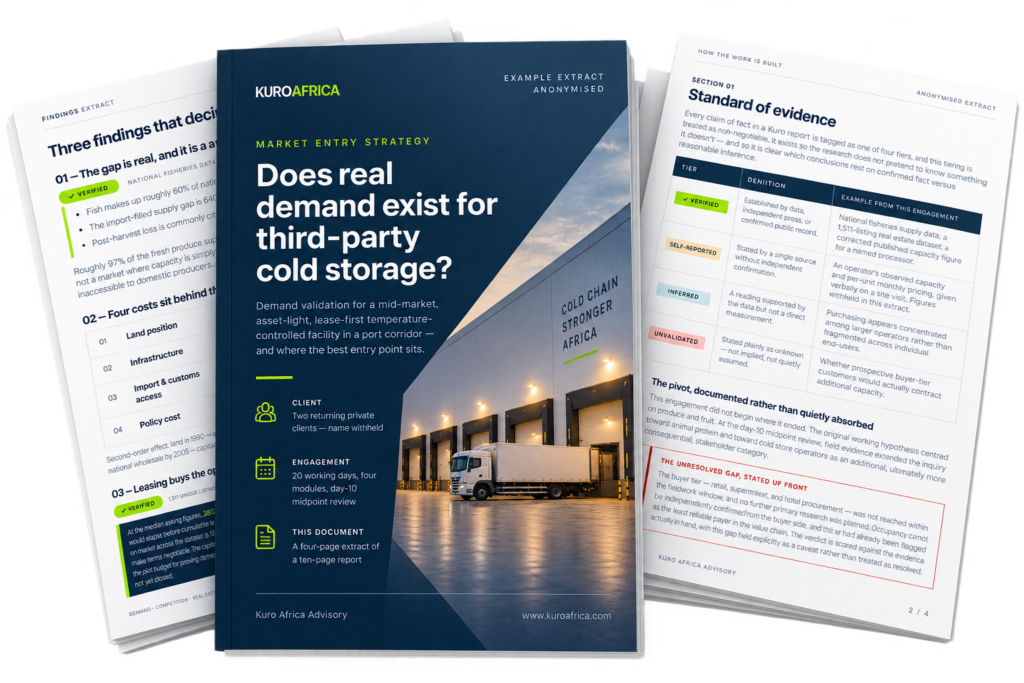
A go/no-go study for investors considering a mid-market, ~500-ton, lease-first cold storage facility near the port. This abridged sample shows how we work and what the client received — not the findings they paid for.

Select a tier to highlight every claim that carries it

Prepared for

Private investors, anonymised at the client’s request

Prepared by

KuroAfrica — independent of developer, operator and agent

Full report

28 pages · 7 sections · 15 stakeholder interviews

This sample is abridged. Client identity, named sources, operator and buyer names, pricing benchmarks, rent figures, candidate sites and the recommended entry routes are withheld. Where a finding is withheld, the sample says so.

01The question

The question was never whether cold storage is needed

The client asked whether to enter Ghana’s cold storage market with a mid-market facility in the Tema corridor, leased rather than built, close to the port. Cold storage is plainly needed in Ghana. The question we were engaged to answer was narrower and harder: does demand for leasable, third-party cold storage exist independently of the import flows through Tema port — and if it does, where is the best entry point?

Sector
Cold storage, mid-market, ~500-ton scale
Geography
Tema corridor
Operating model
Lease-first, asset-light, port-proximate
Structure
Four modules · midpoint review · final playback · weekly written updates
Verdict instrument
Weighted go/no-go score out of 100, on criteria set for this engagement
02How we worked

Four modules, three stakeholder tiers, one standard of evidence

The four modules

  • Demand validation — structured interviews across the value chain
  • Competitive landscape — who holds capacity, and why
  • Location & real estate — a de-duplicated warehouse listings dataset and a lease-versus-buy test
  • Decision framework — weighted scoring and a plain-words verdict

Fieldwork

  • A — Producers, farmers & exporters7
  • B — Retail, restaurant & hotel procurement4
  • C — Cold store operators & handlers4

Plus a site visit, sector association interviews and a warehouse dataset of 1,511 unique listings.

Every claim carries its evidence tier

This is the single most important thing we sell. Every claim of fact in a KuroAfrica report is tagged, and a tier is never upgraded to make a finding land harder.

TierMeansHow it appears in this engagement

Data, independent press, or confirmed public record.

National fish-supply statistics; the warehouse listings dataset.

One source, no independent confirmation.

An operator’s verbal capacity and price on a site visit.

A reading supported by the data, not directly measured.

A buying pattern seen consistently across several interviews.

Stated plainly as unknown.

Why a purpose-built cold store in a prime location sits available.

03Selected findings

The gap is real. Who fills it is the question.

The structural gap

Public fisheries data
  • Fish is roughly 60% of national animal protein consumption
  • Imports fill roughly 50% of national fish supply
  • Post-harvest loss is commonly cited around 30%, within a published range of 10–50% — treated as a band, not a point estimate

A fit gap, not a capacity gap

Most of the fresh produce chain operates with no cold storage at all. The capacity that exists is structurally inaccessible to domestic producers and mid-tier handlers. That distinction shaped every module that followed.

The captive pattern

The operators that hold the corridor’s cold capacity appear to have built it for their own import-and-distribute businesses, not to lease it out. Whether the same holds further down the chain was the question the buyer interviews were designed to answer.

Desk research and operator interviews
Withheld

Named operators, the historical build-up of the incumbent tier, capacity corrections, and what each buyer said — including the one opening we found, and its condition.

Get this for your sector →

Pricing and real estate

There is no transparent public tariff for cold storage in Ghana. Indicative prices vary by more than an order of magnitude per tonne between tiers — and that variance is not contradictory data. The warehouse dataset needed heavy cleaning: 85.8% of raw listings were re-posts of the same property.

Withheld

Tiered pricing benchmarks, median rents by floor size, the lease-versus-buy arithmetic, candidate locations and a live cold store identified in the corridor.

Scope a study like this →
04Decision framework

How the go/no-go decision is scored

A market entry study closes with a weighted decision score out of 100 and a verdict in plain words: go, no-go, or go with conditions. The criteria and weights are set for each engagement. Each criterion states what earned its points and what scored it down, and a weak criterion is never rounded up.

Demand evidence

Is there demand for what the client would sell — confirmed, not assumed?

35%
— / 35

Competitive positioning

Who the client would really compete with, and whether an entrant can reach the same customers.

25%
— / 25

Location & execution

Whether the sites, real estate economics and operating model hold up.

25%
— / 25

Regulatory & operational

Power, tariffs, policy and the risks that sit outside the client’s control.

15%
— / 15
Weighted decision score— / 100
Withheld

The scores, the reasoning behind each, the verdict, the risk flags, and the recommendation that follows from them — including the alternative entry routes, the conditions before committing capital, and the named conversations to take next.

Get a verdict on your market →

One conclusion we can share

This is not a hands-off business. Capacity, custom and information move through relationships, and buyers ask for a track record before they engage. Asset-light reduces the capital at risk; it does not reduce the management load. Any entry needs direct, on-the-ground oversight.
05The full report

What the client received

28 pages across seven sections, built on 15 stakeholder interviews.

SectionContents
—Executive summary, with coverage stated up front
01Engagement overview, including the hypothesis pivot at the midpoint — documented, not smoothed over
02Demand validation: macro data, commodity segmentation, value chain economics, buyer-side and supply-side evidence
03Competitive landscape: how the incumbent tier was built, four competitive archetypes, capacity corrections
04Location & real estate: listings analysis, lease-versus-buy, location thesis, a live site signal
05Decision framework: model choice, pricing evidence, comparable models, site visit, weighted scoring and verdict, risk flags
06Fieldwork and stakeholder landscape
07Recommendation: entry routes, conditions before committing capital, and who to speak to next
Evidence before capital

Considering a new sector in Ghana?

A market entry strategy tells you whether the demand is real before you commit capital to it — and says so plainly when it is not.

If you have already decided and want validation for a decision made, this is not the right engagement.

The call

45 minutes on the sector, the decision you face and your constraints. We scope the question before anything is priced.

What follows

A proposal with modules, fieldwork and the criteria your go/no-go will be scored on.

Anonymised at the client’s requestkuroafrica.com →

See What Our Entry Strategy Looks Like

Get a feel for the detail we help you understand to manage risk in entering African markets

View the Sample